
Experiencing Cairo: Beyond the Page
Understanding How Different Egyptian Arabic Is from Modern Standard Arabic on the Streets
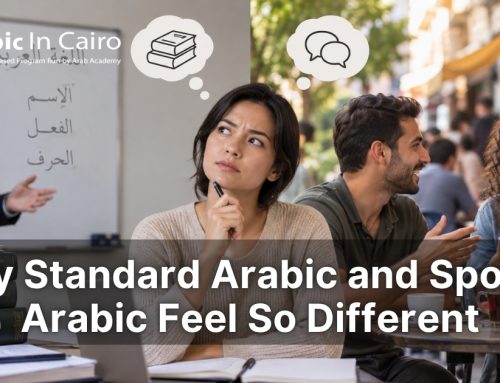
Arriving in Cairo, many learners quickly notice a distinct rhythm to the city’s conversations. You might have diligently studied the modern standard Arabic language, mastering its grammar and vocabulary from textbooks. Yet, when you step into a bustling souk or try to order koshary from a street vendor, the words often feel miles apart from what you’ve learned. This isn’t just a slight accent; it’s a fundamental difference, revealing how different Egyptian Arabic is from Modern Standard Arabic in daily life.
The reality is, while Modern Standard Arabic serves as the formal language of media, literature, and official communication across the Arab world, it’s rarely spoken in casual, everyday interactions. Think of it this way: while you understand the rules of formal English, you probably don’t chat with friends using phrases like ‘one endeavours to ascertain the precise time.’ Cairo, with its vibrant street life, thrives on Egyptian Colloquial Arabic (ECA).
A 2023 report by Statista, for instance, indicates that over 90% of online content consumed by Egyptians is in dialectal Arabic, reinforcing its dominance in everyday communication and showcasing its vitality. This isn’t just about convenience; it’s about cultural identity and connection. Trying to navigate Cairo solely with MSA is like trying to enjoy a local festival by only reading its historical brochure; you miss the experience, don’t you?
Navigating Modern Standard Arabic vs Egyptian Arabic in Cairo
The Practical Differences You’ll Encounter
So, what exactly makes modern standard Arabic vs Egyptian Arabic so distinct? Beyond pronunciation shifts, ECA boasts its own unique vocabulary, grammatical structures, and even different verb conjugations. For example, ‘I want’ in MSA is ‘Ureedu,’ but in ECA, you’ll hear ‘Ana ʿāyez’ (for male) or ‘Ana ʿayza’ (for female). These aren’t minor variations; they are the bedrock of daily conversation.
Consider Emily, a student who arrived in Cairo after two years of intensive Modern Standard Arabic language study. She could read newspapers and understand news broadcasts, but found herself stumped when a taxi driver asked, Rayha fein ?’ (Where are you going?). She realized her formal training hadn’t prepared her for the direct, often rapid-fire, exchanges of Cairo. This experience highlights the critical need to engage with the living language.
Many learners find themselves in a similar situation. They might feel frustrated initially, yet this feeling quickly turns to excitement as they begin to unlock the city’s true voice. The beauty lies in understanding both. While MSA provides a robust foundation, ECA allows you to truly immerse yourself, connecting with locals and truly feeling at home.
Your Path to Fluency: Immersing Yourself in Egypt
Why Learning in Cairo Makes All the Difference
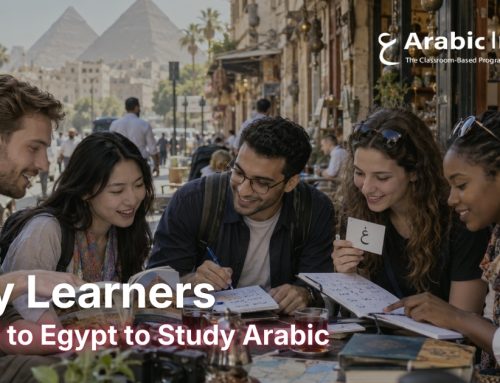
Learning Arabic in Egypt offers an unparalleled advantage. It’s not just about classroom instruction; it’s about constant exposure to the language in its natural habitat. Every street sign, every conversation you overhear, every transaction becomes a learning opportunity. This continuous immersion accelerates your progress far beyond what any textbook alone could achieve.
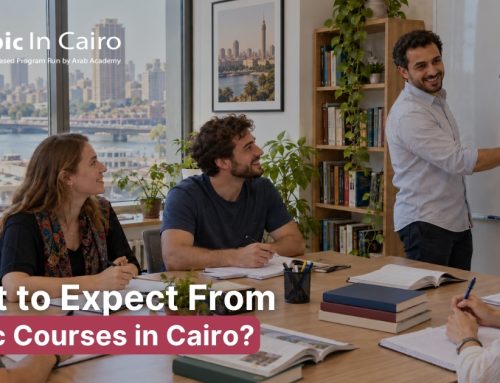
At Arab Academy, we understand this dynamic. We offer comprehensive programs in both Modern Standard Arabic and Egyptian Colloquial Arabic, allowing you to choose the path that best suits your goals. Whether you want to master formal communication or dive deep into daily Cairo life, our courses are designed to provide that crucial balance. Many students find a combined approach to be most effective, building a strong grammatical base while simultaneously developing conversational fluency.
A study by the American Council on the Teaching of Foreign Languages (ACTFL) consistently points to the effectiveness of immersion environments for language acquisition, noting that learners in such settings often achieve higher proficiency levels faster due to constant real-world application. This principle is at the heart of our approach in Cairo.
Imagine ordering your favourite falafel sandwich, haggling at Khan el-Khalili, or simply chatting with locals in their own tongue. These aren’t just language exercises; they are authentic cultural experiences that deepen your understanding of Egypt. We don’t just teach you words; we help you find your voice in Cairo.