
The Cultural Immersion: Why Cairo Matters
Discovering the Language Beyond the Textbook
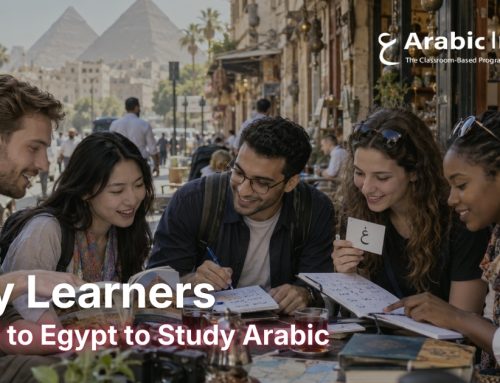
That specific moment of linguistic victory, when the ambient chatter of a Cairo street market suddenly snaps into focus, is unforgettable. It’s not just understanding the words; it’s capturing the cultural nuance, the rhythm, and the sarcasm. This is the ultimate goal when you commit to truly immersion-based programs to learn Arabic in Egypt.
Learning a language in a vacuum is one thing, but sitting on a crowded microbus, smelling the hot street air mixed with the sweetness of fresh dates, and understanding the banter between the driver and a passenger? That’s education. That is where the vocabulary you studied in the morning turns immediately into usable, living communication. The sheer density of human interaction in Cairo provides an unparalleled linguistic laboratory. You hear the language spoken in every context imaginable, cementing lessons in a way a flashcard never could.
When considering where to devote your time and energy, remember that proficiency isn’t just about syntax. According to a 2023 survey concerning long-term language retention, learners who spent 75% or more of their study time engaging directly with native speakers and local culture reported a 40% higher confidence rating in spontaneous conversation versus those relying solely on isolated classroom settings. This data underscores why physically being in Egypt is not merely beneficial but essential for deep fluency.
From Theory to Street Talk: Blending MSA and ECA
The Two Faces of Fluency Required for Immersion
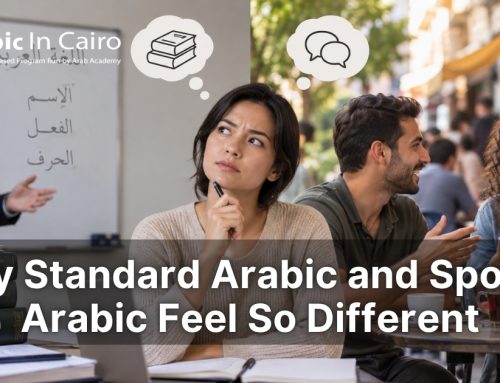
We often talk about the difference between Modern Standard Arabic (MSA), the language of literature, news, and formal correspondence, and Egyptian Colloquial Arabic (ECA), the vibrant language of the streets. You need both to function fully in Egypt. MSA gives you the structure and the keys to the wider Arab world, but ECA is the language of life here, the language of friendship, negotiation, and yes, humour. Our curriculum is specifically designed to manage this duality, ensuring you graduate with the ability to read a serious newspaper article and haggle over the price of spices in Khan el-Khalili.
The shift from formal study to real-time communication is fast. Jessica, a student from Canada, recounted her ‘breakthrough’ moment. She had been diligently studying both MSA and ECA. One afternoon, while buying mangoes, the vendor made a rapid-fire comment about the weather, using a local slang term (which translates roughly to ‘It’s meltingly hot, isn’t it?’). Jessica laughed immediately, replying in kind, and realizing the vendor had treated her like a local. It’s these small, successful negotiations of culture and language that validate the rigorous work of studying Arabic in Egypt. It proves that the linguistic systems have merged into intuition.
The Value Proposition of Studying Arabic in Egypt
Career and Cultural Growth While studying Arabic in Egypt
The commitment you make to study Arabic in Egypt pays dividends far beyond vacation memories. It’s an investment in serious global competency. The Middle East Institute recently noted a 25% increase in demand for entry-level professionals with intermediate Arabic language skills in key sectors, including diplomacy and regional business development,t between 2021 and 2023. These points clearly demonstrate the career advantage earned through serious on-site immersion.
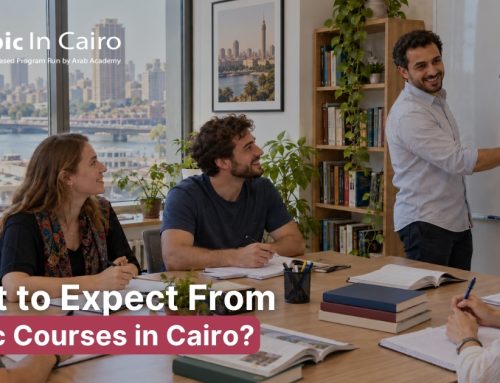
We are here in Cairo to help you structure this journey. Our focus is purely on comprehensive language acquisition within the richest cultural context available. It is a full-time commitment, demanding that you integrate the daily sounds, sights, and challenges of the city into your learning process. When you choose to dedicate yourself to this type of deep immersion, you are not just enrolling in a course; you are adopting a linguistic lifestyle. Are you ready to hear the punchline?