
Connecting the Past to the Present Conversation
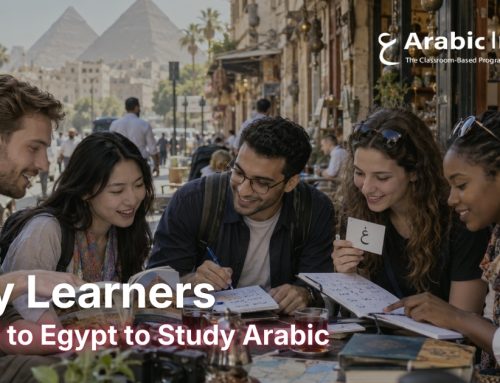
Stepping off the plane in Cairo, you aren’t just entering a city; you are plunging into a symphony of sound: the horns, the call to prayer, and, most importantly, the quick, melodic cadence of daily conversation. It’s here, amidst the timeless dust and the vibrant chaos, that you truly begin to appreciate the remarkable Arabic language evolution. For learners committed to fluency, understanding the language means understanding the culture, and the journey begins when you realize the formal structure learned in textbooks only sets the stage for the dynamic, rich Egyptian Colloquial Arabic (ECA) spoken on the streets.
We know many language enthusiasts come to Egypt seeking authenticity, but often struggle to bridge the gap between Modern Standard Arabic (MSA) structure and real-world dialogue. That sense of disconnection can be frustrating. We bridge that gap by situating your learning experience right where life happens, providing context that no online course ever could. After all, the very history of Egypt is etched into the way its people talk.
Tracing the Roots: Exploring the Origins of Arabic in Cairo
Why the Linguistic Heritage Matters for Modern Speakers
To speak Arabic effectively, we must respect where it comes from. Understanding the origins of Arabic isn’t just an academic exercise; it informs why certain vocabulary is favoured and why grammatical rules are occasionally bent in daily speech. The vastness of the language is impressive.
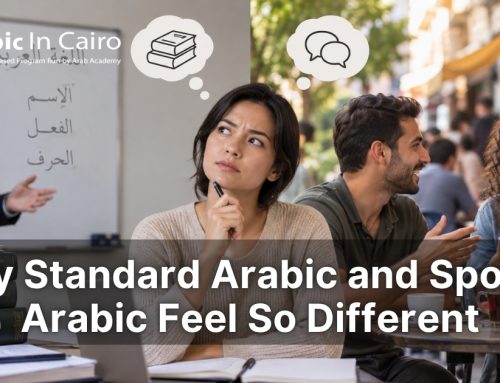
We focus on teaching both MSA, which provides the bedrock structure for understanding media and written works, and ECA, which unlocks instant cultural immersion. This dual approach acknowledges the diglossia inherent in the language. For example, knowing the formal root of a verb often makes interpreting local slang much easier. This duality is a vital step in mastering the evolution of the language in its current form. You begin to hear the echoes of history in every negotiation for a taxi fare or every invitation to tea.
Mastering the Flow: Essential Arabic learning tips for immersion
Strategies for Rapid Fluency On Location
When you are physically immersed, the sheer volume of spoken input naturally accelerates learning. Research consistently supports this, often suggesting that immersion can accelerate acquisition speed significantly compared to classroom-only settings, simply because the brain is constantly active. But immersion alone isn’t enough; you need targeted, actionable Arabic learning tips.
One of our most successful strategies is the ‘3-Minute Conversation Challenge.’ Instead of focusing solely on perfect grammar, students are encouraged to initiate three completely unscripted, spontaneous interactions daily, however simple. This forces the learner to process and react in real-time.
Another crucial tip: Listen for tone and gesture, not just words. Egyptian culture is high-context, meaning much of the communication happens outside the verbal realm. Our courses are designed around real-life scenarios, from navigating public transportation to handling formal bureaucratic interactions to ensure your learning is instantly applicable.
Your Immersion Experience in the Heart of Egypt
Dedicated On-Site Learning in Cairo
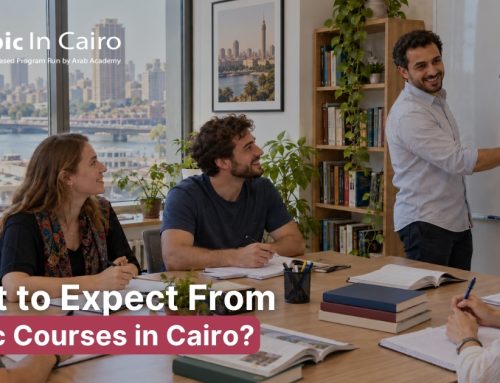
If you are looking for genuine mastery, coming to Cairo is non-negotiable. Our academy is dedicated entirely to providing a specialized experience focused on practical communication. We specialise in teaching both Modern Standard Arabic (MSA) and Egyptian Colloquial Arabic (ECA), offering programs that allow students to focus on one or combine both disciplines, depending on their professional or personal goals. We ensure your classroom learning immediately translates to competence outside.
We focus heavily on situational relevance. You are not just learning vocabulary; you are learning how to operate within Egyptian society. We provide a structured environment to master the intricacies of the language while allowing you the freedom to explore the wealth of Egyptian history and culture outside of class. Our location in Cairo puts you at the nexus of the Arab world, ensuring that every time you step outside, you are engaging directly with the culmination of the rich, ongoing evolution of Arabic.