
Connecting History to Modern Immersion in Cairo
Stepping into the vibrant chaos of Cairo, you quickly realize you’re entering not just a city, but a living linguistic museum. The sounds around you, the rhythmic street calls, conversations over strong coffee, and everyday exchanges are direct descendants of a long and layered past. Understanding Arabic language evolution helps you unlock the culture beneath the words. Learning Arabic isn’t just memorizing vocabulary; it’s connecting modern speech to ancient trade routes, poetry, and social life that shaped it.
Many learners ask: Why does history matter if I just want to order koshary? It matters because pronunciation, structure, and formal Arabic all come from this lineage. Arabic is one of the most widely spoken languages in the world, yet its richness goes far beyond numbers. Studying in Egypt places you at a unique crossroads where history meets living, spoken Arabic every single day.
Tracing the Ancient Roots and Origins of Arabic
From Inscriptions to Modern Scripts
To understand the origins of Arabic, we look back thousands of years to the northern Arabian Peninsula. Arabic didn’t appear overnight; it evolved gradually from earlier Semitic languages. Evidence of this transition appears in Nabataean and Safaitic inscriptions carved into stone across desert regions. These scripts reveal how letter shapes, sounds, and structures slowly transformed into the Arabic alphabet we recognize today.
This historical continuity explains why Modern Standard Arabic (MSA) remains so structurally consistent across countries. For learners, this offers reassurance: once you understand the system, it travels with you.
One insight we emphasize early is the role of sound and context. Arabic’s emphatic consonants, the “heavy” sounds that define its character, are not arbitrary. They developed in environments where subtle sound differences mattered in fast-paced communication. When you practice these sounds in Cairo, you’re engaging the same physical articulation used centuries ago. Immersion works because your brain connects sound, place, and movement at once, accelerating fluency naturally.
The Shift: MSA vs. Colloquial Reality in Egypt
Navigating Diglossia
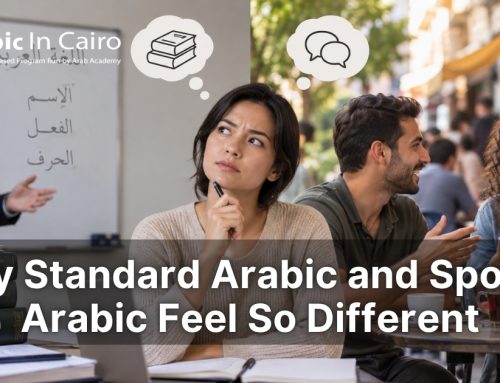
Arabic’s evolution led to diglossia: a formal variety (MSA) and everyday spoken dialects. In Egypt, Egyptian Colloquial Arabic (ECA) dominates daily life, media, and social interaction. MSA appears in newspapers, official speeches, and formal writing but not in taxis or cafés.
True fluency in Cairo means understanding both. That’s why learning programs here often combine MSA with ECA or offer them separately, depending on your goals.
Egyptian Arabic is especially influential because Egyptian film, television, and music are widely understood across the Arab world. One student from Canada, Liam, focused solely on MSA at first. He could read headlines but struggled with daily interactions. Once he added ECA negotiating prices and chatting with shopkeepers, the language finally clicked. MSA helped him read; ECA helped him live.
Practical Immersion: Essential Arabic Learning Tips for Cairo
Making the City Your Classroom
If you’re serious about immersion, these Arabic learning tips will help you maximize your time in Cairo:
- Use the environment. Associate vocabulary with places, colours, and fabrics in markets, food terms while ordering ta’ameya, directions while navigating streets.
- Listen constantly. Passive listening trains your ear, even when you don’t understand everything.
- Learn phrases, not words. Full exchanges are more useful than isolated vocabulary.
- Accept mistakes. Egyptians are welcoming and encouraging; effort matters more than perfection.
Every interaction becomes a lesson when you approach the city intentionally.
Frequently Asked Questions (FAQ)
Your Path to Fluency in Egypt
What types of Arabic do you teach?
We focus on Modern Standard Arabic for reading and formal use, and Egyptian Colloquial Arabic for daily communication. You can study them separately or together.
Why study Arabic in Cairo?
Because immersion accelerates learning. From microbuses to neighbourhood conversations, Cairo turns every moment into real-world practice, bridging classroom learning with lived experience.