
Launching Your Professional Immersion Journey in Egypt
In today’s global economy, where emerging markets drive much of the world’s growth, Arabic is quickly shifting from a “nice-to-have” skill into a professional advantage. We know that holding a certificate alone isn’t enough. What professionals need is practical Arabic that works in meetings, negotiations, and day-to-day business interactions. That’s why focused training in business Arabic, delivered through immersion in Cairo, makes a real difference.
Across international commerce, the MENA region plays a growing role especially in sectors such as renewable energy, finance, infrastructure, and logistics. Egypt, positioned as a gateway between Africa, the Middle East, and Europe, sits at the center of this activity. If your goal goes beyond classroom fluency toward career-driven communication, immersion is the most effective starting point. The challenge, of course, is knowing how to navigate professional Arabic without being overwhelmed by dialects or unfamiliar business norms.
Why Cairo Is the Ultimate Classroom for Professional Arabic
Gaining Context Through Immersion
Language learning is never just about vocabulary. It’s about understanding tone, timing, and cultural context especially in business. Cairo offers an unmatched environment where commerce, negotiation, and daily interaction happen constantly. You don’t just study Arabic here; you live it, from morning meetings to informal conversations over coffee.
Egypt remains one of the top destinations for foreign direct investment in the Arab world, reflecting its central economic role. This means your learning takes place alongside real commercial activity, not in isolation. Training where business actually happens gives you immediate context for how Arabic is used professionally and why subtle differences in phrasing or delivery matter.
Navigating the Cairo Market: Beyond Textbook Arabic
Blending Formal Language with Street-Smart Communication
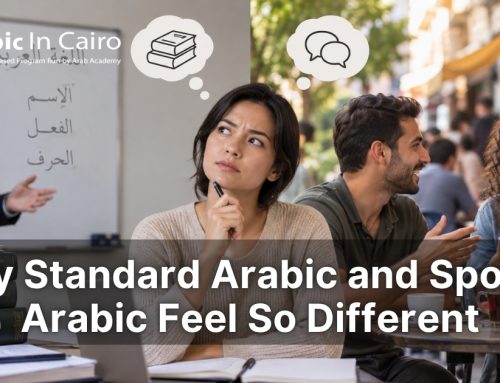
Modern Standard Arabic (MSA) is the foundation of professional communication. It’s the language of contracts, formal emails, presentations, and official documents. But business in Egypt and across the region doesn’t run on formality alone.
Building trust often depends on Egyptian Colloquial Arabic (ECA). These everyday exchanges are where relationships are strengthened and problems are solved. Imagine negotiating with a local supplier: while the agreement is written in MSA, the conversation that builds confidence, clarifies expectations, or resolves last-minute issues usually happens in ECA.
Our immersion programs focus on both forms of Arabic, either separately or combined, depending on your goals. You learn how to shift naturally between formal and informal registers a skill that’s extremely difficult to develop outside an Arabic-speaking environment. We also emphasize industry-specific vocabulary and negotiation language, ensuring that what you learn is immediately usable in professional settings.
The Tangible Returns: Career Growth Through Linguistic Fluency
Applying Business Arabic in Real Situations
Specialized language skills create measurable career advantages. Recent industry research shows that professionals with business-level Arabic proficiency are significantly more likely to be placed in client-facing roles involving regional travel and leadership responsibilities.
Take Sarah, an engineer from Chicago assigned to manage a project near the Suez region. At first, she depended heavily on translators, which created distance between her and the local team. After completing an intensive business Arabic program in Cairo focused on technical vocabulary and negotiation strategies, her role changed dramatically. She was able to communicate directly, build trust, and navigate sensitive discussions with confidence.
One critical moment involved resolving a contractual ambiguity with a government utility. The documents required precise MSA, while the discussions demanded cultural awareness, indirect phrasing, and relationship-focused communication in ECA. By using both effectively, Sarah secured approvals ahead of schedule and strengthened long-term partnerships.
This is the real value of business Arabic: reduced friction, clearer communication, and stronger professional relationships.
Frequently Asked Questions (FAQ)
Your Practical Guide to Learning Arabic in Cairo
Where is your academy located?
We are based in Cairo, Egypt, offering fully immersive, in-person programs.
Which Arabic forms do you teach?
We teach Modern Standard Arabic (MSA) for formal and written communication, and Egyptian Colloquial Arabic (ECA) for daily interaction and relationship building, both essential for effective business communication.