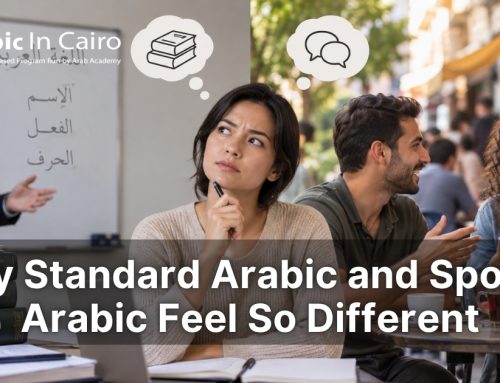

Discovering True Arabic Comprehension Through Immersion in Egypt
Imagine navigating the bustling souks of Cairo, the vibrant conversations flowing around you like a melodic river. You might not catch every single word, but suddenly, you grasp the essence, the emotion, the offer being made. This isn’t magic; it’s the art of developing your Arabic comprehension, a skill that moves beyond rote memorization into a natural, intuitive understanding. For anyone looking to truly master how to understand Arabic, especially through robust Arabic listening practice, the key lies in training your ear to connect dots, infer context, and perceive the bigger picture.
Recent observations from language learners often highlight a common frustration: getting stuck on individual words, losing the thread of a conversation. It’s a natural hurdle, but one that direct, immersive learning environments like ours in Cairo are uniquely positioned to overcome. Instead of feeling overwhelmed, our students quickly learn to lean into the flow of communication, focusing on key phrases, body language, and shared cultural cues that paint a clearer picture of what’s being said.
Why Immersion in Egypt Sharpen Your Arabic Listening Practice
Beyond the Classroom: Cairo as Your Dynamic Language Lab
While textbooks offer foundational grammar, true proficiency blossoms in environments where the language lives and breathes. Consider a 2023 report from the British Council, which emphasized that “meaningful interaction and cultural immersion significantly accelerate language acquisition, often reducing the time to proficiency by up to 50% compared to traditional classroom settings alone.” This isn’t just theory; it’s what we see daily in Egypt.
When you step out into the streets of Cairo, every interaction becomes an opportunity to refine your Arabic listening practice. Ordering a cup of tea from a local vendor, bargaining for spices, or simply enjoying a friendly chat with new acquaintances, these aren’t just cultural experiences; they are vital, real-time lessons. You’re constantly challenged to process information quickly, infer meaning from context, and engage actively. This constant, gentle pressure builds an intuitive understanding that is difficult to replicate online.
Take Liam, for example, a student from Ireland who joined our program last year. He initially struggled with the pace of spoken Egyptian Colloquial Arabic (ECA). But after just a few weeks of living in Cairo, engaging daily with shopkeepers and his local neighbors, he found himself able to follow entire conversations, even anticipating responses. His ‘aha!’ moment came when he successfully negotiated a taxi fare without catching every number spoken, relying instead on gestures, tone, and the common patterns of negotiation. That kind of progress is organic, born from necessity and a supportive environment.
Mastering Context to Learn Arabic Listening Effectively
The Art of Inference in Both Modern Standard Arabic and Egyptian Colloquial in Cairo
The beauty of language isn’t just in its vocabulary; it’s in its context. Whether you’re focusing on Modern Standard Arabic (MSA) for academic or professional settings, or diving deep into Egyptian Colloquial Arabic (ECA) for daily life in Cairo, understanding context is paramount. It involves picking up on common phrases, recognizing intonation, and even interpreting non-verbal cues. This comprehensive approach is central to how we teach you to learn Arabic listening.
A study by Cambridge University Press highlighted that language learners who actively employ ‘inferencing strategies’ when encountering unfamiliar words are significantly more successful in retaining new vocabulary and improving overall comprehension. Our instructors guide you through scenarios where these strategies are put into practice, providing immediate feedback in a supportive, engaging atmosphere.
We also integrate cultural insights seamlessly into our lessons. Understanding the nuances of Egyptian hospitality, for instance, can provide a wealth of contextual clues in a conversation, making it easier to grasp implied meanings even if specific words are new to you. This holistic approach ensures your ear doesn’t just hear sounds, but truly processes meaning.