
Discovering Arabic in the Heart of Cairo
Stepping out into the bustling streets of Cairo is an immediate immersion, a sensory explosion of sights, sounds, and smells. It’s also, perhaps surprisingly, one of the most dynamic environments for anyone seeking practical tips to learn Arabic faster. Forget rigid textbooks for a moment; the real classroom here is the vibrant interactions you’ll have, from haggling over spices in Khan el-Khalili to ordering koshary from a street cart. This is where language truly lives, breathed by everyday Egyptians.
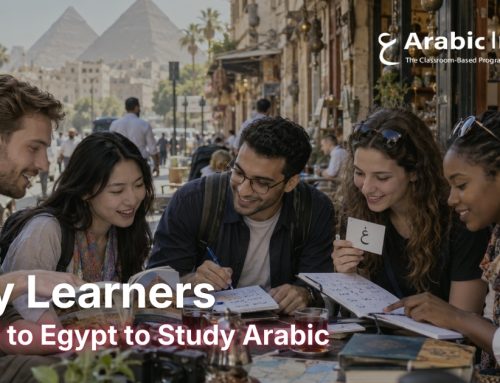
For newcomers to Egypt, the initial thought might be to stick to English. However, data consistently show the power of immersion: research by the American Council on the Teaching of Foreign Languages (ACTFL) highlights that immersive experiences significantly accelerate language acquisition, often doubling the proficiency rate compared to classroom-only learning. This isn’t just about understanding grammar; it’s about internalizing the rhythm and flow of conversation. And in Cairo, your ‘teachers’ are everywhere, eager to chat.
Embracing Everyday Conversations: Practical Tips to learn Arabic language
Beyond the Classroom: Learning ‘Ana Ayez’ and ‘Kam?’
So, how do you translate the academic into the everyday? It starts with simple bravery. Next time you’re at the greengrocer, instead of pointing, try to ask, b kam kilo al tamatem?’ (How much does a kilo of tomatoes cost?) Even if your pronunciation isn’t perfect, the effort is genuinely appreciated. Vendors are remarkably patient and often delighted when foreigners attempt their language. This isn’t just a transaction; it’s a cultural exchange, a small bridge built with words.
Consider Matthew, a student from the USA who joined our program in Cairo. Initially shy, he started with just ‘Shukran’ (Thank you) and ‘Ma’alesh’ (Never mind/It’s okay). Within weeks, encouraged by his Modern Standard Arabic lessons, he challenged himself to manage an entire interaction at a local bakery using Egyptian Colloquial Arabic. He started with ‘Sabah el kheir!’ (Good morning!), then ‘Ana ayez eish baladi’ (I want baladi bread), and finally, ‘Kam?’ for the price. The baker, seeing his effort, corrected his pronunciation gently and offered a few new phrases. That small victory propelled Michael forward, demonstrating that practical, daily application is key for anyone serious about learning Arabic.
A recent study by Rosetta Stone further reinforces this: learners engaged in daily conversational practice with native speakers achieved conversational fluency up to four times faster than those relying solely on textbooks. This isn’t just theoretical; it’s observable in the rapid progress of our students right here in Cairo.
From ‘Salam’ to Sentences: Building Your Egyptian Vocabulary
The Art of Active Listening and Repetition
The street is a masterclass in active listening. When a taxi driver gives you directions, try to catch the key nouns and verbs: ‘Yameen’ (right), ‘Shemal’ (left), ‘Dughri’ (straight). Don’t be afraid to ask, Ya’ani eh…?’ (What does… mean?). Most people are happy to explain. Repeat what you hear. If a shopkeeper says ‘Afwan’ (You’re welcome), try to say it back. Repetition, especially in context, solidifies new words far better than flashcards alone.
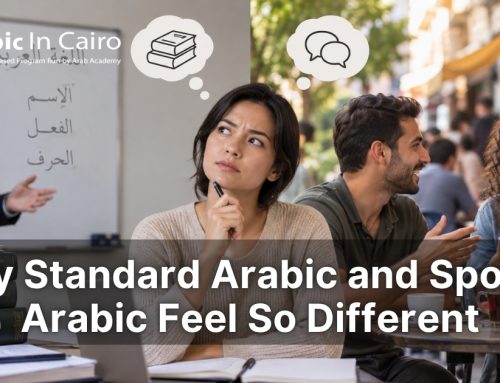
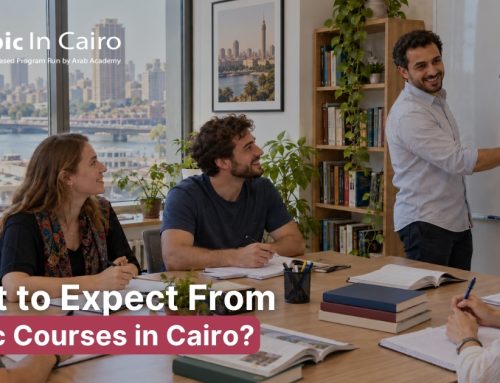
Our language programs in Cairo are designed to complement this organic learning. We offer a comprehensive approach to both Modern Standard Arabic (MSA) and Egyptian Colloquial Arabic (ECA), recognizing that while MSA provides the foundational grammar and widely understood vocabulary, ECA is your key to daily life here. You can choose to focus on either or combine them based on your goals. Imagine learning the formal structure of a sentence in class, then immediately applying its colloquial equivalent when bargaining for a souvenir. This synergy makes language acquisition incredibly efficient and truly one of the best tips to learn Arabic faster.
Beyond Words: Understanding Egyptian Culture Through Language
The Heart of Communication in Cairo
Learning Arabic in Egypt isn’t just about vocabulary; it’s about understanding a rich culture. When a street vendor offers you tea while you browse, it’s not just hospitality; it’s an invitation for connection. Accepting and engaging, even with limited Arabic, opens doors to genuine human interaction. You’ll pick up on nuances of politeness, humour, and daily life that no book can teach. These moments of shared humanity are invaluable for truly integrating into your new environment.