
Starting Your Immersion Journey in Egypt
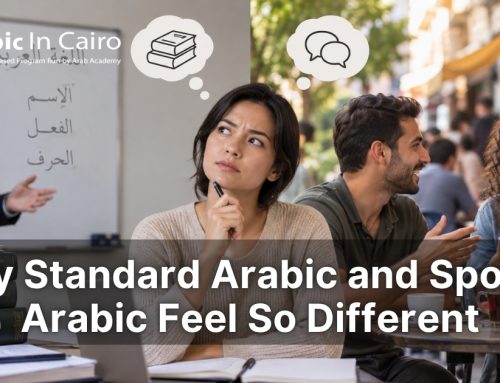
That initial moment of realization hits many language learners right after they land in Cairo: the Arabic being spoken on the street, in the crowded markets, and by the taxi drivers sounds nothing like the formal textbooks. You start wondering, ‘Am I doing this right? Is there something wrong with the way I’m trying to learn the language?’ The truth is, there’s a gap between Modern Standard Arabic (MSA) and the vibrant, living vernacular. We understand this challenge completely, which is why when planning how to learn Arabic effectively, you need a strategy that embraces both sides of the linguistic coin. Immersion in Egypt solves this dichotomy instantly.
The language ecosystem here is unique. While MSA provides the necessary grammatical framework and is essential for reading news or formal communication, the daily chatter requires Egyptian Colloquial Arabic (ECA). Learning here means you are constantly exposed, forcing your ear to adapt. It’s not about correcting the speakers; it’s about adjusting your expectations and recognizing that true fluency means mastering both the formal language and the dialect of your environment. That contextual depth is something no app can replicate.
Mapping Out How to Learn the Arabic Language Step by Step
Bridging the Gap Between MSA and Dialect
A successful learning path isn’t chaotic; it’s structured, even within an immersion setting. Many ask how to start learning Arabic, and our answer usually emphasizes a balanced approach. While it’s highly recommended to combine Modern Standard Arabic (MSA) and a dialect—since MSA provides a shared roof for vocabulary, syntax, and formal communication—you can also start directly with a dialect. Some learners thrive by immersing themselves in a dialect first, picking up practical communication skills, and gradually layering MSA knowledge as needed. Combining both approaches, however, gives the most flexibility and depth in real-world Arabic usage. Our process guides you systematically, whether you start with MSA or a dialect. You begin with the alphabet and sound system in MSA, while simultaneously introducing practical Egyptian Colloquial Arabic (ECA) structures relevant to daily life in Cairo. This ensures you aren’t just memorizing phrases, but building an adaptable framework. Think of it like learning to drive: you need to understand the mechanics (MSA), but you also need street practice (ECA) to navigate traffic.
The Power of Immersion: More Than Just Classroom Time
How to Learn Arabic Through Local Experience
Choosing to study in Cairo offers a level of contextual learning unmatched by remote study. When we discuss `how to learn the Arabic language step by step`, we emphasize the environment itself as the greatest teacher. You might spend two hours in a focused classroom session, but then you spend the next eight hours negotiating prices for fresh fruit or ordering koshary, that is where the learning cements itself.
A recent analysis by Deloitte (2024) highlighted that learning retention rates increase dramatically when theoretical knowledge is immediately applied in real-world, high-context scenarios. In language learning, this translates directly to immersion. When Daniel, a student from the UK, arrived, he struggled with fast-paced conversation. After just four weeks of combined MSA and ECA study, integrated with daily interaction, he was able to successfully chat with his local baker about the quality of the ‘aish (bread), not just using textbook phrases, but authentic Egyptian idioms. That confidence boost is priceless.
Taking the Next Step to Learn Arabic in Cairo
Your Practical Guide to Starting
There is no perfect time to begin, but there is an optimal environment. For those who ask, `How to start learning Arabic?`, the immediate step is deciding where your focus lies. If your goal is truly conversational fluency and cultural understanding, being physically present in a vibrant city like Cairo is the catalyst.
We offer comprehensive courses in both Egyptian Colloquial Arabic and Modern Standard Arabic, individually or in combination, designed specifically for non-native speakers. Our methodology ensures that by the time you step out of the classroom, you feel ready to engage with the world outside. Stop seeing the dialects as barriers; start viewing them as doors to deeper cultural understanding. Cairo is waiting to teach you.