
Learning basic Arabic words and developing conversational fluency happens remarkably quickly when you’re fully immersed. Our in-person programs in Cairo, Egypt, offer a direct route to mastering everyday interactions, connecting you deeply with the language and culture from day one.
Why Learn Arabic in Egypt? An Immersive Journey
Beyond Textbooks: Real-World Basic Arabic Conversation
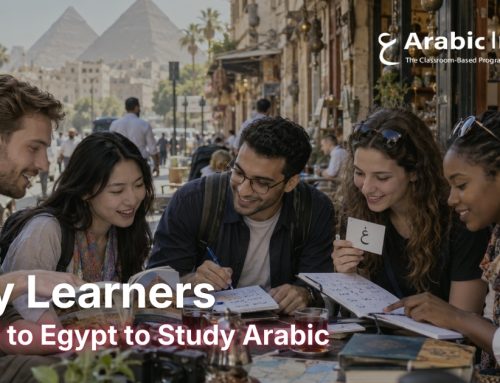
Imagine stepping out of your classroom and into a bustling market, where every interaction is a chance to practice. That’s the power of learning Arabic in Egypt. You’re not just memorizing phrases; you’re living them. This constant, real-life exposure is a game-changer for building confidence and developing natural listening and speaking skills.
Research consistently shows the profound benefits of immersion for language acquisition. A meta-analysis of language immersion programs found that students often perform as well as, or even better than, their non-immersion peers on standardized language assessments. This isn’t just about grades; it’s about making the language stick in a way that traditional classroom settings often can’t match. When you’re ordering ‘koshary’ or haggling for spices, those basic Arabic conversation skills become second nature.
Consider the experience of David, a student from Canada who joined our program last year. He initially struggled with spoken Arabic, finding textbook examples too rigid. After just a few weeks of daily interactions in Cairo, from chatting with local shopkeepers to navigating the metro, he found his fluency soared. He shared, ‘Every street corner was a lesson. I learned more practical Arabic in a month here than I did in a year of online classes. It’s like the city itself became my teacher.’ This kind of active, daily use accelerates learning and helps overcome the common fear of making mistakes.
Building Your Basic Arabic Vocabulary Foundation in Cairo
Essential Basic Arabic Words for Daily Life
When you’re learning in Egypt, your vocabulary grows organically, tied directly to your experiences. You’ll pick up words for food, transport, and greetings just by being present. This contextual learning makes remembering new basic Arabic words much easier and more meaningful. For instance, you’ll quickly learn that ‘Shukran’ (thank you) is essential everywhere, and you’ll hear ‘Afwan’ (you’re welcome) in return.
Learning Egyptian Colloquial Arabic (ECA) offers a significant advantage, as it is widely understood across the Arab world due to Egypt’s influential media and entertainment industry. This means the basic Arabic vocabulary you acquire here will serve as a linguistic bridge, enhancing your ability to communicate with a broader audience.
Here are some foundational basic Arabic words and phrases you’ll quickly master for daily interactions in Cairo:
- As-salamu alaykum (السلام عليكم): The universal greeting, meaning ‘Peace be upon you.’
- Wa alaykum as-salam (وعليكم السلام): The polite response to the greeting.
- Sabah al-khair (صباح الخير): Good morning.
- Masa’ al-khair (مساء الخير): Good evening.
- Shukran (شكرا): Thank you.
- Min fadlik (من فضلك): Please (to a female).
- Min fadlak (من فضلك): Please (to a male).
- Aywa (ايوه): Yes.
- La’ (لا): No.
- Izzayak? ( إزيك؟ ): How are you? (to a male).
- Izzayak? (إزيك ؟): How are you? (to a female).
- Ana bekhair, alhamdulillah (أنا بخير، الحمد لله): I’m fine, praise be to God.
- bekam de? (بكام ده؟): How much is this?
- Yalla (يلا): Let’s go!
Tailored Learning: Your Basic Arabic Course in the Heart of Egypt
Crafting Your Path as a Basic Arabic for Beginners Learner
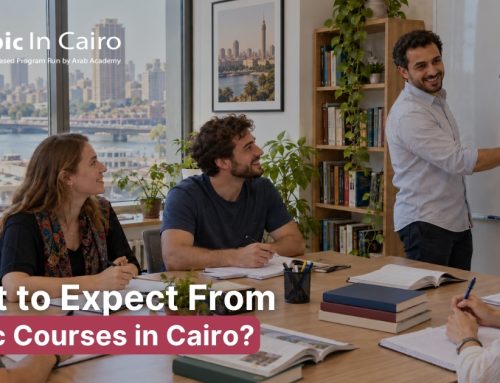
Our academy in Cairo is designed to support every basic Arabic for beginners student. We understand that starting a new language can feel overwhelming, so our programs are structured to build your skills progressively. You get direct access to experienced instructors who are native speakers, offering personalized guidance that online platforms simply cannot replicate.
We offer comprehensive courses in both Modern Standard Arabic (MSA) and Egyptian Colloquial Arabic (ECA). You can choose to focus on one or combine both, depending on your learning objectives. MSA provides a strong foundation for reading, writing, and formal communication, widely used in media and literature. ECA, on the other hand, opens doors to everyday interactions and deeply understanding Egyptian culture.
Many students find that learning ECA first or alongside MSA quickly builds their confidence for daily life in Egypt.