
Why Egyptian Arabic Dominates Among Arabic Dialects
Stepping into the world of Arabic can feel overwhelming initially. There isn’t just one Arabic language; there are vibrant, often challenging, regional variations, commonly known as Arabic dialects. For anyone aiming for maximum practical utility and cultural immersion, the choice quickly narrows. We are talking, of course, about Egyptian Arabic.
The sheer influence of the Arabic Egyptian dialect cannot be overstated. When a student decides to learn egyptian dialect, they are tapping directly into the cultural hub of the Middle East. Consider the scale: Egypt has the largest population in the Arab world, roughly 110 million people as of 2024, according to demographic reports. This massive native speaker base gives its dialect an unmatched reach. But it is not just population; it is soft power. Think about the movies, the television dramas, the classic songs; nearly every Arab home, from Morocco to the Gulf, has grown up consuming media produced in Cairo. This cultural saturation means that even if someone does not speak the Egyptian dialect, they likely understand it.
Choosing to learn the Egyptian language is essentially choosing the lingua franca of Arab popular culture. It is the language you will hear most frequently outside of news broadcasts or religious texts like the Qur’an, which uses Modern Standard Arabic (MSA).
The Bridge Between Formal and Conversational Arabic
The Cultural Resonance of the Egyptian Dialect
For learners who may have some background in Modern Standard Arabic, making the jump to speaking colloquially can be jarring. MSA provides the foundational grammar, but it rarely prepares you for the lively, fast-paced conversations on the street. This is where mastering the Arabic Egyptian dialect becomes invaluable. It serves as a practical bridge.
Take, for example, the simple scenario of travel. I recall a student, Sarah, who was working in Dubai. She had spent a year studying formal Arabic, yet felt isolated socially. Once she began her journey to learn the Egyptian dialect, everything shifted. She told us how suddenly she could follow the punchlines in the local coffee shop, realising a joke was a direct quote from an old Adel Imam film. That sense of instantaneous cultural connection of finally being ‘in’ on the conversation is the true reward of learning colloquial Arabic. The ability to use expressions and slang that resonate universally makes communication richer and far more empathetic.
Furthermore, a 2023 report by the Modern Language Association (MLA) indicates that enrollment in Arabic language courses remains strong, often driven primarily by cultural and professional interest. This trend underscores the growing demand for conversational fluency over purely classical study, a fluency that Egyptian Arabic offers readily.
Structured Guidance: How to Learn Egyptian Arabic Effectively
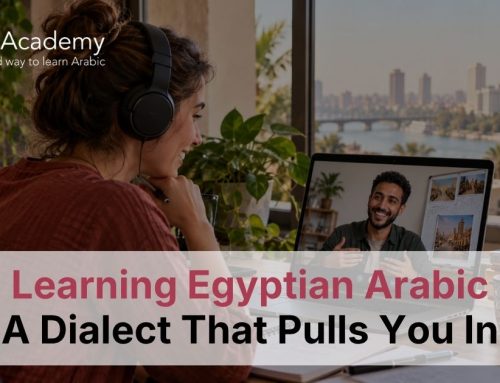
Practical Application: Learning Egyptian Dialect Online
It can feel overwhelming, right? You recognize the necessity of learning this key dialect, but where do you start when the textbooks primarily focus on MSA? Arab Academy understands the need for structured guidance when learning Arabic. We know that successful learners thrive when given authentic materials and expert instructors who are native speakers, teaching the nuances that cannot be picked up from a dictionary.
To truly master the rhythm and flow of the language, personalized learning is crucial. Flexible Learning Options: We offer a range of flexible learning options tailored to your schedule and budget, including self-paced courses and live, one-on-one online classes. This blended approach ensures you get the deep immersion needed to speak, not just translate, truly. We focus specifically on practical Egyptian dialect online methodologies, moving you swiftly from understanding basic vocabulary to holding complex conversations.
When you decide to learn Egyptian Arabic, you are investing in a proven methodology designed for real-world application.
FAQs About Learning Egyptian Arabic
Common Questions from Students Who Want to Learn Egyptian Dialect
Is Egyptian Arabic the hardest dialect to learn?
No, many students find Egyptian Arabic relatively easier because of its widespread presence in the media. Access to movies, music, and television makes finding practice material much simpler compared to less widely broadcast Arabic dialects.
Do I need to learn Modern Standard Arabic before I learn Egyptian dialect?
While having an MSA foundation helps grasp grammar structure, it is not strictly necessary to start with MSA. You can successfully begin to learn the Egyptian dialect immediately, especially if your primary goal is conversational fluency and daily communication.
Does Arab Academy offer courses in Quranic Arabic?
No. We specialize in teaching Modern Standard Arabic and Egyptian Colloquial Arabic, focusing on contemporary usage and real-world communication.