
Unveiling the Local Approach to Language Learning in Cairo
Stepping into the bustling streets of Cairo, you’ll quickly notice a unique warmth in every interaction. Beyond the vibrant sights and sounds, there’s a subtle yet significant linguistic dance at play, especially when Egyptians engage with non-native speakers. They instinctively adjust their Arabic, a testament to their renowned hospitality, making it easier for you to grasp and participate. This natural adaptation is a huge advantage for anyone wondering how to learn conversational Arabic effectively, right here in the heart of Egypt.
It’s not just about simplifying words; it’s about a genuine desire to connect. Imagine ordering koshary from a street vendor or haggling for spices in Khan el-Khalili. You might find them slowing down their speech, choosing simpler vocabulary, or even repeating phrases with a smile. This isn’t out of pity, but a proactive effort to bridge the language gap, a cornerstone of Egyptian culture. This collaborative spirit makes the immersion experience incredibly rewarding, transforming every daily encounter into a mini language lesson.
Understanding the Nuances of Egyptian Hospitality in Language
More Than Words: The Cultural Empathy of Egyptian Communication
The way Egyptians modify their speech for learners is deeply rooted in their cultural values. It’s a widely observed cultural trait, often highlighted in travel guides, that Egyptians extend remarkable hospitality, or ‘karam,’ to visitors. This extends directly to how they communicate. They genuinely want you to feel comfortable and understood, which often means meeting you halfway linguistically. This isn’t just a pleasantry; it’s an active effort to facilitate communication.
Consider Maria, a student from Canada, who recounted her experience trying to buy fresh fruit. “I fumbled with my few Arabic phrases, but the shopkeeper immediately switched to slightly simpler Egyptian Colloquial Arabic, using gestures and clearer pronunciation. He even taught me the word for ‘sweet’ by offering a sample. It felt less like a transaction and more like a friendly exchange,” she shared. This kind of spontaneous, supportive interaction is invaluable. A 2023 survey by Preply highlighted that nearly two-thirds (65%) of language learners find interaction with native speakers to be the most effective learning method, and Cairo offers this in abundance.
From MSA to ECA: Navigating the Language Spectrum in Egypt
How Egyptians Blend Formal and Colloquial for Learners
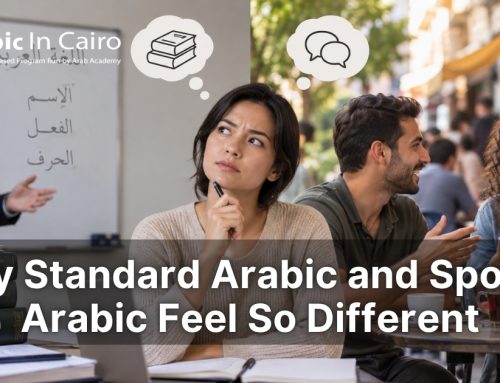
When you’re trying to learn how to speak Arabic in Egypt, you’ll encounter two main forms: Modern Standard Arabic (MSA) and Egyptian Colloquial Arabic (ECA). While MSA is used in formal settings and media, ECA is the everyday language. Egyptians often intuitively gauge your proficiency and might initially use simpler MSA terms before transitioning to ECA, or they might stick to a simplified ECA, avoiding complex slang or rapid-fire idioms. This flexibility is a huge asset for learners.
They’re not just simplifying grammar; they’re strategically choosing words that are more universally understood or closer to what you might have learned in initial lessons. This unspoken agreement to meet learners halfway significantly reduces intimidation and builds confidence. Statista reported a steady increase in cultural tourism globally, underscoring a growing desire among travelers to connect authentically with local traditions and languages, and language is the key to unlocking that deeper connection here in Egypt.
Embracing the Immersion Experience in Cairo
Your Direct Route to Conversational Fluency in Egypt
The best way to truly benefit from this linguistic generosity is by immersing yourself fully. Being physically present in Cairo means every corner offers an opportunity to practice and observe. You’re not just learning vocabulary; you’re absorbing intonation, body language, and the cultural context that gives words their true meaning. Isn’t that the most effective way to truly grasp a language, by living it?
Our programs in Cairo are designed to leverage this unique environment, offering both Modern Standard Arabic and Egyptian Colloquial Arabic. Whether you choose to focus on one or combine both, you’ll find that the real-world application of your lessons with native speakers accelerates your learning journey. This direct engagement fosters a deeper understanding of how to learn conversational Arabic, making your experience in Egypt truly transformative.