
Stepping Off the Plane: Why Cairo is the Ultimate Classroom
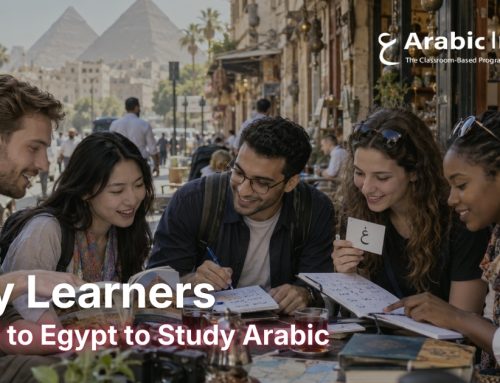
The decision to learn a new language is always significant, but choosing where to learn defines the entire journey. Have you ever felt the frustration of rote memorization, where vocabulary sticks only until the exam finishes? That cycle stops the moment you land in Cairo. When the sheer scale of the city washes over you, the historical density, the constant hum of conversation, you realise this is not just a place to study; it’s a living, breathing laboratory for language acquisition.
To truly master the dialect spoken across the region, nothing replaces being surrounded by the flow of native speakers. This is precisely why our intensive Arabic course is anchored right here, providing not just lessons, but constant cultural integration. We understand that finding the perfect Arabic language course requires striking a balance between rigorous structure and practical application, which is why we’ve designed our programs specifically for the dedicated learner seeking full immersion.
Beyond the Textbook: The Power of Immersion in Egypt
Choosing Your Path: Modern Standard and Colloquial Arabic
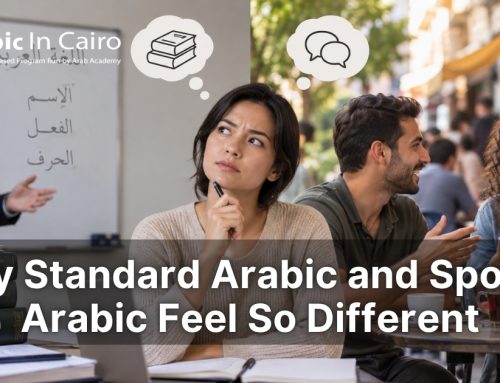
Current market observations consistently show that global careers, especially in diplomacy, media, and development, require proficiency not only in formal Arabic but also in the everyday dialects used for building rapport. While Modern Standard Arabic (MSA) provides the foundational grammar and is the language of literature and official communication, Egyptian Colloquial Arabic (ECA) is the key to daily life, from ordering street food to understanding popular media. Our Arabic courses are strategically structured to ensure fluency in both.
This dual focus addresses a major industry challenge: bridging the gap between classroom knowledge and real-world conversation. The US Foreign Service Institute (FSI) rates Arabic as a Category IV language, noting the significant time commitment required for English speakers to reach professional working proficiency. This isn’t meant to discourage you, but rather to highlight why immersion is not a luxury, but a necessity. By taking an Arabic course in Cairo, you multiply your learning speed because the city acts as your mandatory practice partner.
We prioritize skills that matter immediately. We don’t focus on Quranic or Classical Arabic; we focus on what allows you to engage with contemporary Egypt and the wider Arab world right now.
Navigating the Alphabet: Structured Arabic for Beginners
From Zero to Conversational: A Beginner’s Journey
The Arabic script can feel like an impenetrable wall for the newcomer. If you are seeking Arabic for beginners, we start with the essentials, making the script, sounds, and initial grammar manageable and engaging. We move quickly beyond simple greetings to functional phrases that you can deploy the moment you leave the classroom.
Consider Liam, who came to us from Manchester last year. He knew precisely zero Arabic upon arrival. The immediate challenge for him wasn’t the grammar, but mustering the courage to use the few words he knew. Within three weeks of enrolling in our intensive program, Liam wasn’t just reciting verbs; he was successfully haggling for a small antique coffee pot in the bustling Khan el-Khalili market using simple but effective ECA phrases. That small victory, securing a fair price through language, is a transformative experience that cements the learning far more deeply than any written test.
This kind of success is possible because our teaching methodology focuses on practical communication first. Our goal is to transform that initial intimidation into actionable confidence, making the whole journey toward fluency achievable, one conversation at a time.
Real Skills, Real City: Applying Your Arabic Courses
The Cairo Advantage: Learning Where the Language Lives
Why commit to an in-person Arabic language course experience? The answer lies in the auditory saturation of Cairo. Every taxi ride, street vendor interaction, and dinner conversation exposes you to subtle nuances in intonation, speed, and regional variations that no audio track can replicate. This high level of exposure accelerates proficiency significantly.
Language acquisition research broadly suggests that students engaging in full immersion typically acquire language proficiency two to three times faster than those studying only in a non-immersive environment. When you couple our structured curriculum with the daily, necessary practice of living in Egypt, the results are powerful.
We are here to provide the structure, the expert instructors, and the community. You provide the commitment to step out every day and speak. It is this synergy between the classroom and the street that makes our Arabic course in Cairo a superior investment in your future fluency. When you are ready to move beyond passively hearing Arabic to actively speaking and living it, Cairo is waiting.
Frequently Asked Questions About Learning Arabic in Cairo
Everything You Need to Know Before You Enrol
Do you offer both Modern Standard Arabic (MSA) and Egyptian Colloquial Arabic (ECA)? Yes, we offer comprehensive programs covering both MSA, which provides the formal structure and foundation, and ECA, which is essential for daily life and immersion while living in Egypt.
Are these courses suitable for complete beginners? Absolutely. We have dedicated Arabic for beginners tracks that start with the very basics of the alphabet, phonetics, and essential communicative grammar, structured to build confidence quickly.
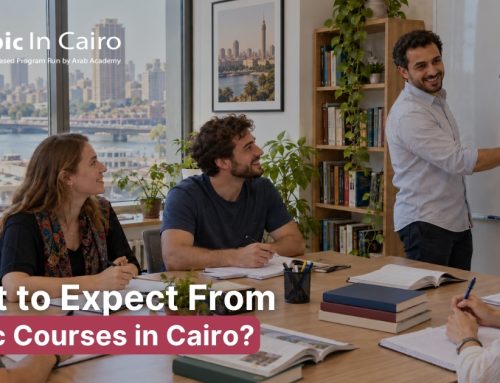
What teaching method do you use? Our method is communication-focused, blending grammatical instruction with immediate practical use. Lessons are dynamic and interactive, ensuring students spend maximum time actively producing language.
Are the courses held in person only? We offer both in-person courses at our facilities in Cairo, Egypt and online Arabic courses. Our in-person programs emphasize full cultural and linguistic immersion, while our online courses follow a structured curriculum and provide high-quality instruction for students who prefer or require remote learning.