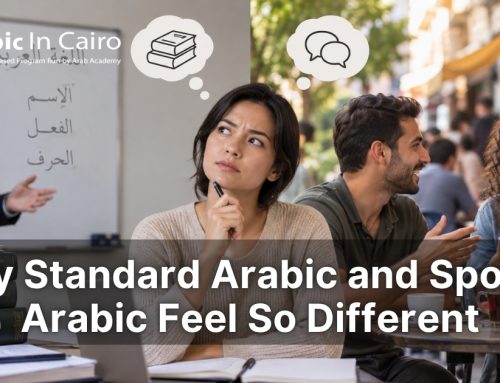

Why Standard Arabic Doesn’t Cut It on the Street
The heat hits you the moment you step out of Cairo International Airport, a vibrant, chaotic energy that begs participation. Yet, many international visitors find themselves grappling with a profound silence once they leave the world of textbooks behind. They have mastered the elegant script of Modern Standard Arabic (MSA), but when the taxi driver asks a quick question in Egyptian Colloquial Arabic (ECA), the fluency vanishes. If you are here to truly experience the depth of Egyptian culture, mastering practical Arabic conversation is not optional; it’s the key that opens the city.
We understand the pain point: you don’t want to spend months learning grammar rules only to freeze when ordering koshary. You need immediacy. Our focused, in-person Arabic conversation classes are specifically designed to bridge this gap, ensuring that the dialogue you practice in the classroom is the same dialect you hear echoing through the souqs of Khan el-Khalili. The goal is simple: to make you functionally conversational from day one, grounding your theoretical knowledge in real-world use here in Cairo.
Immersion: The Only True Way to Learn Conversational Arabic
Why You Must Learn Conversational Arabic in Cairo
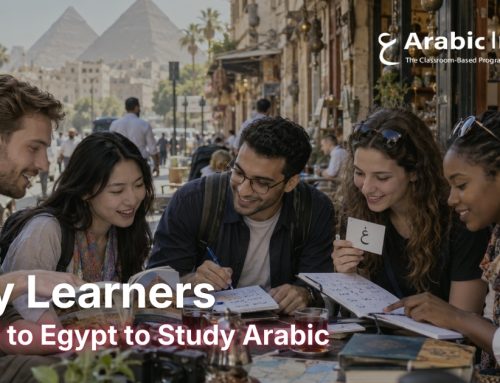
Forget online modules and static video calls. Language acquisition, particularly for a rich dialect like ECA, thrives on sensory the smell of spices, the rhythm of negotiation, and the non-verbal cues. This is why location matters so profoundly. When you learn conversational Arabic here in Egypt, your classroom extends far beyond the four walls of our academy.
It’s an acknowledged principle in linguistic studies that context drives retention. Specifically, research often referenced in language acquisition reports (such as those detailing methods from the Defence Language Institute) suggests that immersion environments can accelerate fluency by up to three times compared to studying in a non-native environment. Simply put, when every interaction, from buying mangoes to confirming directions, becomes a live listening exercise, your brain is forced to adapt rapidly. Our program leverages this high-immersion environment, making daily life in Cairo an integral part of your Arabic language conversation lessons.
Consider this insight: Egypt holds a dominant position in regional media, producing the vast majority of Arabic-language films, music, and television dramas. This means the Egyptian dialect is widely understood, making ECA not just useful for travel in Egypt, but across the entire Arab world. By focusing on ECA, you are investing in a globally relevant skill set, not just a local dialect.
Building Blocks: Conversational Arabic for Beginners and Beyond
Finding the Right Conversational Arabic Course Structure
We structure our curriculum around practical utility, moving quickly past theoretical debates and straight into actionable communication. Whether you are a total newcomer or someone looking to polish existing MSA knowledge, we have pathways tailored for your starting point. If the sounds and letters of Arabic are entirely new to you, our Arabic conversation for beginners tracks prioritise phonetic mastery and essential phrases immediately.
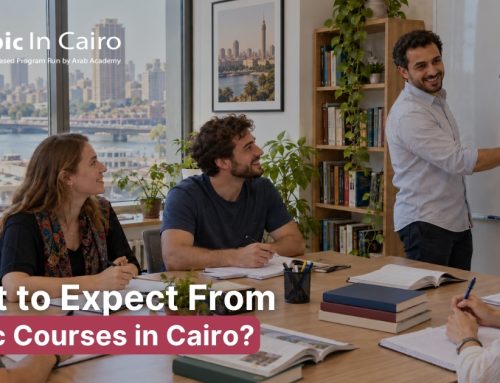
Our specialised conversational Arabic course is intense, designed for fast results. We emphasise situational role-playing: simulated doctor visits, haggling scenarios, and discussions about current Egyptian events. These are not dry lectures; they are dynamic conversational Arabic classes built around scenarios you will encounter within the first week of exploring Cairo.
For those who worry about taking the plunge, think of Liam, an architecture student from London who joined us last autumn. He started with zero knowledge. By week four, after numerous conversational Arabic lessons focusing purely on market dialogue, he successfully negotiated a better price for traditional copperware in Khan el-Khalili, saving 30% of the original asking price. This isn’t just about saving money; it’s about accessing a deeper, more respectful level of engagement with the community. That sense of accomplishment is priceless, and it proves that fluency begins with confidence, not complexity.
Practice Makes Permanent: Maximising Your Arabic Conversation Practice
Moving from Classroom Role-Play to Real-Life Dialogue
The biggest differentiator between rote learning and true mastery lies in dedicated, consistent Arabic conversation practice. Our approach integrates structured classroom time with guided ‘fieldwork’ assignments. You might be asked to interview a shop owner about their daily routine or navigate a specific route using only Arabic. This transforms potentially intimidating interactions into structured learning opportunities.
We ensure that every lesson is heavy on speaking time. Unlike large, impersonal institutions, our small class sizes guarantee that you receive personalised feedback on pronunciation and rhythm. According to a 2023 language acquisition survey conducted by HubSpot, learners cited a lack of practical speaking opportunities as the number one barrier to achieving fluency. We directly counter this by ensuring that the majority of your time is spent generating language, not just consuming it.
When you learn Arabic conversation in this immersive environment, the language stops feeling like an academic subject and starts feeling like a tool for living. Our goal is to make sure you walk away from our program not just understanding Arabic, but genuinely thinking in it, ready to engage fully with the rich, historical tapestry that is Egypt.
Frequently Asked Questions (FAQ)
What You Need to Know Before You Start Your Journey
Q: Are your courses Modern Standard Arabic (MSA) or Egyptian Colloquial Arabic (ECA)?
A: We offer instruction in both Egyptian Colloquial Arabic and Modern Standard Arabic, allowing students to choose their focus based on their individual learning objectives, whether for daily communication, immersion in Egypt, or reading and formal contexts.
Q: Do I need any prior Arabic knowledge to enroll?
A: Absolutely not! We offer dedicated streams for arabic conversation for beginners. We start from the very basics of sound production and simple dialogue, guiding you step-by-step toward fluency.
Q: What is the typical class size?
A: We maintain small class sizes, typically between 4 to 8 students. This ensures maximum speaking time for everyone and allows our instructors to provide detailed, individualized feedback on your arabic conversation practice.